
National RiskWi$e Conference 2026 & Wallendbeen Workshop
Background
FarmLink is a partner in RiskWi$e, the National Risk Management Initiative funded by GRDC. FarmLink’s involvement in the project is focussed on Nitrogen decision making, but the scope of the national project extends to decisions around machinery purchases and natural capital management, as well as other farming decisions.
FarmLink is part of the NSW Action Research Group (ARG), which holds periodic ARG meetings both online and in person. Mark Skewes attended a full-day, NSW ARG meeting in Dubbo on February 10, 2026.
The RiskWi$e National Conference is a two-day event where partners from the ARGs across Australia meet to hear reports on some of the activities carried out as part of the project in the previous 12 months and discuss project focus and activities going forward.
The 2026 RiskWi$e National Conference was held in Bendigo on June 23 & 24, 2026. Mark Skewes attended the conference on behalf of FarmLink.
Attendees
The official attendance list for the conference numbered 85 people, although a number of those listed were not present.
Attendees from the NSW ARG included Skye Traill (AMPS Agribusiness), Kate Coffee (Riverine Plains), Damien Jones (Irrigation Farmers Network), Maurie Street (Grain Orana Alliance) and Cindy Cassidy (Southern NSW Innovation Hub).
Conference Program
The conference featured a mix of presentations, breakout groups and a panel discussion.
Topics covered as presentations included:
Engaging ways to convey risk and probabilities;
5 things I’ve learnt from developing risk decision support tools for grain growers;
N trials – what have we learnt so far?;
From trials to a risk framework: using nitrogen decisions to explore how growers navigate uncertainty;
Creating and understanding RiskWi$e’s impacts;
Reflections on behavioural science workshops and creating impact;
RiskWi$e communication;
To what extent can we link grower attitudes to risk with farming systems decision-making and performance? Marrying 12 months+ of behavioural insights with APSIM modelling analyses; and
Designing the "RiskWi$e Way" of working with growers and advisors.
The Tuesday afternoon breakout groups discussed three different topics:
*Using paddock scale demonstrations to validate research - what can we learn?;
Soil amelioration decisions; and
Financial/machinery decision making.
The two Wednesday morning breakout groups discussed:
*Grower engagement - how to get people to turn up; and
Roadblocks around integrating risk/reward and getting a productive outcome.
*FarmLink’s representative Mark Skewes attended the topics marked by asterisks.
The Wednesday morning panel discussion featured three farmers involved in RiskWi$e activities through Birchip Cropping Group, exploring three key topics:
Decision-making in farming;
Involvement in the RiskWi$e project; and
Have they changed their approach to decision-making? If yes, how and why?
Take Away Messages
RiskWi$e Outcomes
The conference reinforced that the key focus of the RiskWi$e project is to assist people to make better decisions about their farming enterprise. The focus is not on the decisions that are made, but on the process used to make decisions. Key phrases include “slow thinking”, “whole-body decision making” and “DRIVE” (Define, Reflect, Identify, eValuate, Enact).
Farmers are encouraged to consider the range of factors influencing their decision making, and to review how factors such as biases, past experience or personality influence their decisions.
Discussing Probabilities
Peter Hayman (SARDI) presented a session on probability, using the example of what El Nino really means in terms of probability of drier than normal conditions. The key message was that people tend to assume that El Nino means we will definitely have dry conditions, whereas the truth is that it just increases the probability of dry and reduces the probability of wet conditions, but either outcome is still possible, and conditions can shift between wet and dry from period to period. This can be difficult to communicate, but it is important that people understand the difference when using climate forecasting, especially as it impacts on potential crop yield outcomes.
Data Presentation
Brendan Brown (CSIRO) presented a single set of data in 8 different graphical formats and collected responses from the audience about their reaction to the data in each format. This activity clearly demonstrated that the way data is presented can change the message conveyed and people’s responses and decision making.
Nitrogen Trials
James Hunt (University of Melbourne/CSIRO) and Corinne Celestina (University of Melbourne) presented data from all of the Nitrogen trials being undertaken, including FarmLink’s Temora and Harden sites. Their conclusions included that treatments requiring more analytical decision making (for example methods utilising Yield Profit predictions) tend to be more profitable over the long term, but that some low input, simpler methods (such as Replacement plus 30% and N Banking) still achieved good results.
Language
Maurie Street (Grain Orana Alliance) talked about the language we use to express risk, suggested that “uncertainty” is a better way to talk about topics such as climate. This makes it easier to talk about balancing upside and downside uncertainty, whereas risk is generally associated with the downside only.
Engagement
There were a number of presentations about ways to engage with growers around on-farm decision making:
Participatory Action Research (PAR) groups, working with a small group of growers to think through a range of decisions across the course of the season;
Birchip have a group of 14 growers who they contact every month to talk about their current on-farm decisions;
Some groups use their R&D Committee as a form of PAR;
WhatsApp groups can assist with maintaining contact and providing support to growers; and
Birchip Cropping Group ran a series of workshops focussing on “Decision Fit” as a concept, embedding good decision-making practices into everyday operations.
Paddock Scale Trials
Chris McDonough (Malle Sustainable Farming) and Jane Gentry (Qld DPI) led a workshop looking at the use of paddock scale trials. As well as acting as an extension tool, paddock scale trials help to highlight practical issues associated with new practices, potentially modifying recommendations about how to apply treatments, and potentially leading to refinement of processes or machinery.
The value of such trials to growers was demonstrated by the fact that some growers were willing to pay for higher rates of inputs, such as double N rates, because they valued the outcomes of the trials.
FarmLink Events and Opportunities
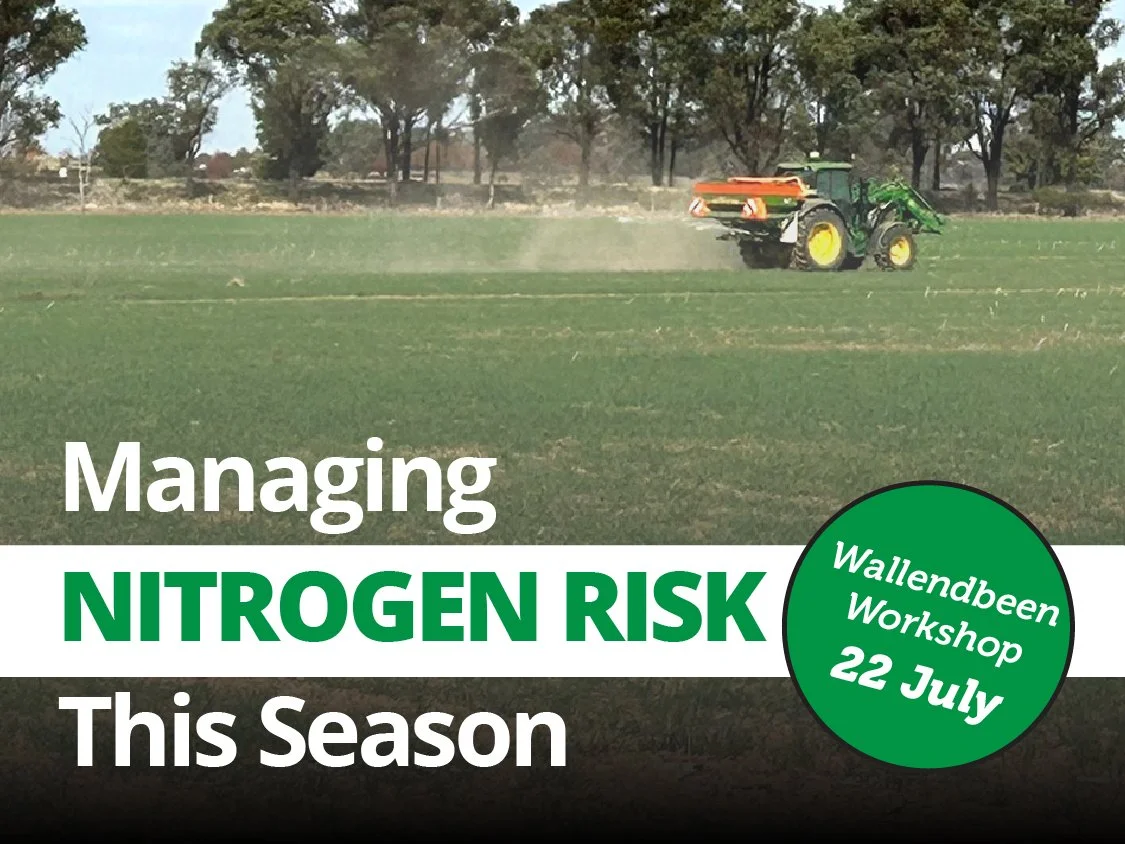
A Managing Nitrogen Risk workshop will be hosted at Wallendbeen on 22 July 2026. The workshop will include reporting on outcomes from the Temora and Harden RiskWi$e Nitrogen trial sites and will then move into a Whole-Body Decision-Making workshop facilitated by Brendan Brown from CSIRO. The workshop will assist participants to explore their decision-making processes, with a focus on Nitrogen application decisions. Please register here.
Many of the principles outlined at the conference are applicable beyond the RiskWi$e project. Some of these principles may be incorporated into other activities carried out by FarmLink, to improve extension and engagement outcomes. This may include:
Setting up WhatsApp groups for specific projects or subjects of interest;
Exercising caution when displaying data, to ensure that the presentation format used is clear and understandable, and supports good decision making; and
Using more paddock scale trials as an accompaniment to plot trials.